The short answer
If your furnace blows cold air, short cycles, makes new noises, or smells of gas or burning, it needs attention. AllPro HVAC Services finds the cause, explains your repair or replacement options with a quote before work starts, and offers 24/7 emergency service across Los Angeles and nearby cities.
Los Angeles winters are mild, so many furnaces sit unused for most of the year. That long idle stretch is why problems often show up on the first cold night. Igniters that worked last spring fail, dust collects on burners and sensors, and filters that were never changed choke airflow. AllPro HVAC Services repairs gas furnaces and their blowers and controls in homes across Los Angeles and surrounding cities. This page covers the warning signs, what our technicians inspect, how to weigh repair against replacement, what affects cost, and what to expect when we come out.
Signs Your Furnace Needs Repair
Some furnace problems are obvious, like no heat at all. Others build slowly and are easy to ignore until the system quits. Call for service if you notice any of the following:
A light dusty smell the first time you run the heat each fall is normal and should fade quickly. A gas smell is not normal. If you smell gas, leave the house, don't flip switches or use appliances, and call your gas utility or 911 from outside. If a carbon monoxide alarm sounds, get everyone outside and call for help first. Once the home is safe, we can diagnose and repair the furnace.
- No heat, or air from the vents that stays cool after the furnace has run for several minutes
- The furnace turns on and off in short bursts and never finishes a full cycle
- Uneven heating between rooms, or weak airflow from vents that used to blow strongly
- Banging or booming at startup, or squealing, scraping, or rattling from the cabinet or ducts
- A burning smell that lingers beyond the first few minutes of the season
- A yellow or flickering burner flame instead of a steady blue one
- A blower that runs nonstop or won't run at all
- A thermostat calling for heat with no response from the furnace
- Higher gas or electric bills without any change in how you use the system
What We Check During a Furnace Repair
A good repair starts with finding the actual cause, not just the part that failed last. Our technician works through the system step by step:
Many no-heat calls come down to a dirty flame sensor, a failed igniter, a clogged filter, or a blocked vent. Safety switches often trip because of an airflow problem somewhere else, so we look for the reason a switch tripped instead of simply resetting it. In most homes the furnace blower also moves air for central air conditioning, so a blower or control problem found in winter can affect summer cooling too, which matters in inland neighborhoods and valleys that get very hot.
- Thermostat settings, wiring, and power, and whether it is actually calling for heat
- Air filter condition and return airflow
- Igniter or pilot assembly, flame sensor, and burner flame
- Gas valve operation and gas pressure at the furnace
- Inducer motor, pressure switch, and venting for blockages or loose connections
- Heat exchanger, inspected for cracks, rust, or signs of overheating
- Blower motor, capacitor, and blower wheel cleanliness
- Limit and rollout switches, which shut the furnace down when something is wrong
- Control board error codes and wiring connections
- Condensate drain and trap on high-efficiency furnaces
Repair or Replace?
Most furnace problems are repairable. Igniters, sensors, motors, capacitors, and switches are replaceable parts, and fixing them is usually the sensible choice. We'll tell you plainly when a repair makes sense.
Replacement deserves a closer look when the heat exchanger is cracked, when the furnace has had several major failures in a short time, when parts are hard to find for an older model, or when the system is the wrong size for the house. A cracked heat exchanger is a safety concern because it can let combustion gases into your living space.
If replacement is on the table, local rules matter. South Coast AQMD Rule 1111 limits nitrogen oxide emissions from natural-gas fan-type central furnaces sold and installed in the Los Angeles region, and the district has been amending it toward zero-emission requirements. The district sets and revises the compliance dates, so check the current rule before planning a new gas furnace. We can walk you through what applies to your home.
Many homeowners also consider a heat pump, which heats and cools in one system and suits our mild winters. LADWP residential electric customers can apply for Consumer Rebate Program rebates on qualifying heat pump systems, with the amount based on the unit's SEER2 and HSPF2 ratings. The application is filed after the equipment is purchased and installed, within 12 months of purchase. Many homes outside the City of Los Angeles are served by Southern California Edison instead, so available rebates depend on your address, and we confirm the current offer before quoting it. The federal Energy Efficient Home Improvement Credit applied only to qualifying heat pumps placed in service before December 31, 2025, so it isn't available for new installations.
What Affects the Cost of Furnace Repair
We give you a clear quote after diagnosis and before any work begins. The cost of a furnace repair depends on several factors:
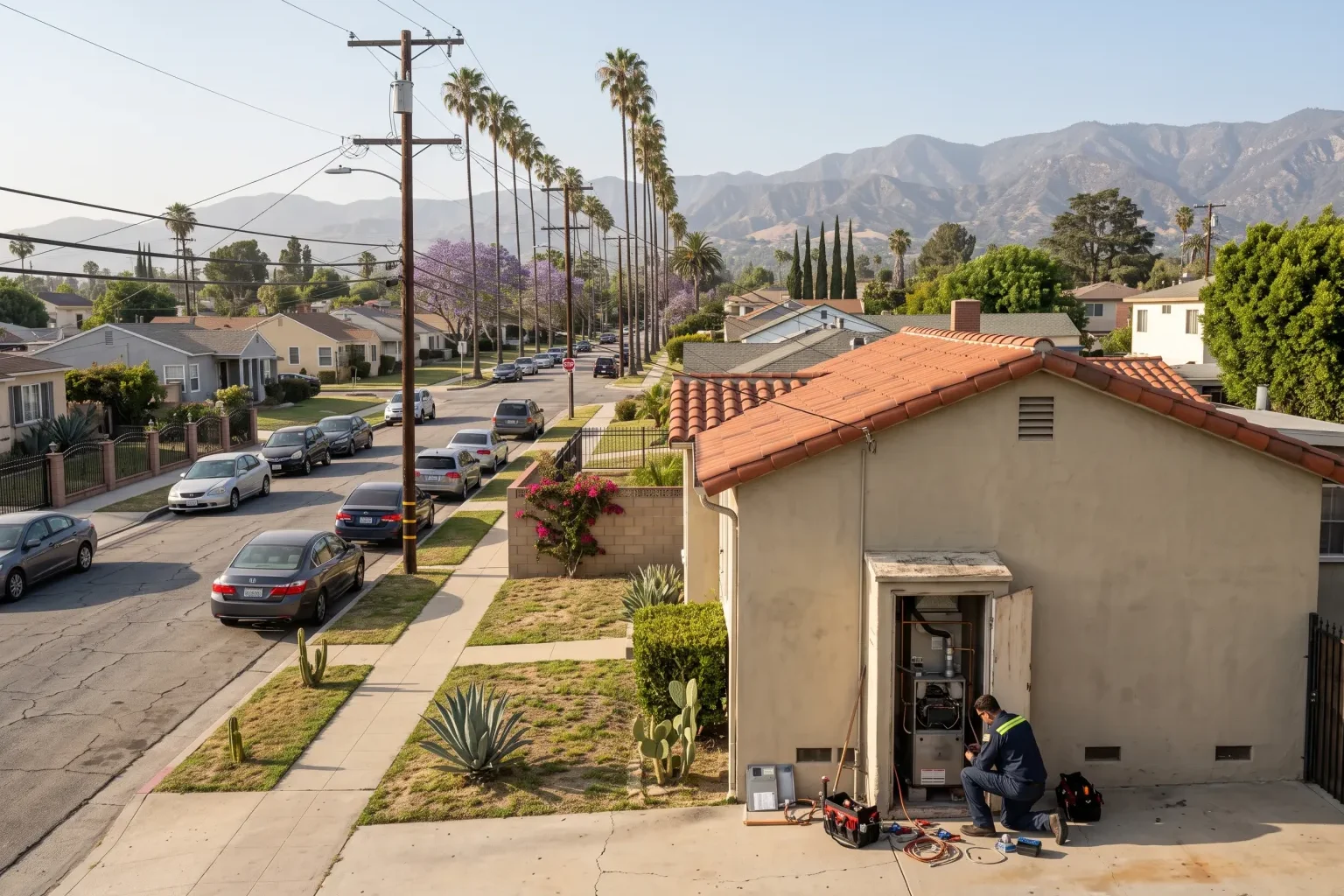
Many local homes have furnaces in attics, garages, or tight hallway closets. Hard-to-reach equipment can add time, and we'll account for that in your quote rather than surprise you with it later.
- Which part failed, and whether it's a common part or a manufacturer-specific one
- Furnace type, such as standard-efficiency, high-efficiency condensing, or variable-speed
- Age and model, which affect parts availability
- Where the furnace is installed and how easy it is to reach
- Related problems, like venting or duct issues, that should be fixed at the same time
- Timing, since after-hours emergency visits differ from scheduled appointments
How a Furnace Repair Visit Works
Before calling, check a few basics: the thermostat is set to heat, the furnace power switch is on, the breaker hasn't tripped, and the filter isn't clogged. These checks occasionally solve the problem on the spot. If they don't, here's what happens next:
- Scheduling: Tell us what you're seeing and hearing, plus any blinking light codes on the furnace. We offer 24/7 emergency service when you need heat right away.
- Diagnosis: The technician inspects the system, tests components, and pinpoints the cause.
- Explanation and quote: You get a plain explanation of the problem and your options, with a quote before work starts.
- Repair and testing: After the repair, we run the furnace through a full heating cycle and check the flame, airflow, and safety controls.
- Recommendations: We point out anything else worth watching, such as a filter that needs changing or wear that may need attention later.
Furnace Repair by city
- Furnace Repair in South Pasadena
- Furnace Repair in Alhambra
- Furnace Repair in Monterey Park
- Furnace Repair in Vernon
- Furnace Repair in Glendale
- Furnace Repair in San Marino
- Furnace Repair in Pasadena
- Furnace Repair in San Gabriel
- Furnace Repair in Maywood
- Furnace Repair in Huntington Park
- Furnace Repair in Commerce
- Furnace Repair in Bell